
Each year, as Easter arrives, the language of resurrection returns to public conversation. Yet resurrection is a word that reaches beyond theology. Even outside formal religion, it gestures toward something deeply human: the stubborn possibility that life can emerge again from places that appear exhausted, forgotten, or closed.
In the Christian story, resurrection is not merely a miracle that happens once. It is a disruption. A reordering. The narrative refuses the finality of violence and despair and insists that history itself can bend toward life.
But long before it became doctrine, resurrection was first an experience. The earliest witnesses did not encounter an abstract idea. They encountered the shock of continuity—the realization that what they thought had ended was somehow still unfolding.
In that sense, resurrection is less about supernatural spectacle and more about the restoration of possibility.
And possibility, when we look closely, is rarely abstract.
It is embodied in people.
In rural parts of Central America, the distance between illness and care can be measured not only in miles—but in generations.
A mother in labor may travel hours to reach a clinic.
A child with a treatable infection may never see a doctor.
Entire communities often rely on under-resourced health posts staffed by overextended nurses or volunteers.
These conditions are not the result of fate. They are the outcome of structural realities—poverty, limited access to education, and the historic exclusion of women from professional opportunity.
Against that backdrop, the decision of a young woman to pursue medical training becomes something quietly radical.
It is an act of reordering the future.
Adelante Mujer exists in the space where possibility begins to reopen.
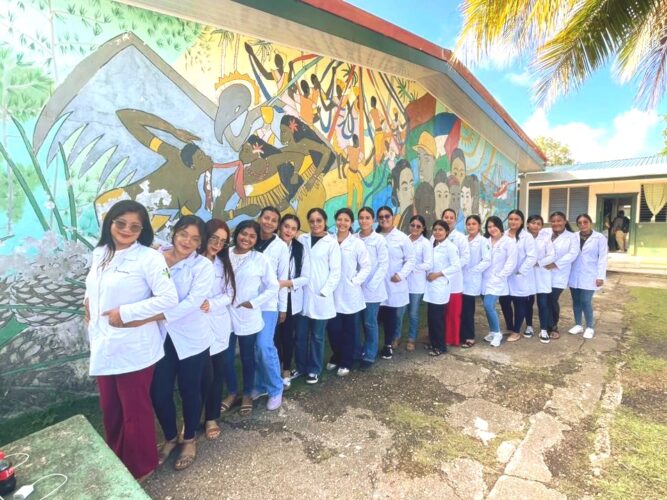
The organization supports women pursuing careers in healthcare—particularly medicine and nursing—through scholarships, mentorship, and long-term accompaniment throughout their education.
At any given time, nearly 100 students are moving through this pathway, many of them the first in their families to attend university.
Medical education demands years of study, clinical training, and financial stability—resources rarely available to women growing up in rural communities. Without support, many of these students would simply have no path forward.
With support, however, something remarkable begins to happen.
A student becomes a graduate.
A graduate becomes a doctor.
A doctor returns to serve a community that has waited generations for care.
The transformation is not symbolic. It is measurable and lasting.
One physician may treat thousands of patients each year. Over the span of a career, that number multiplies into tens of thousands of encounters—diagnoses made, children vaccinated, births attended, lives extended.
What begins as the education of a single woman slowly reshapes the health of an entire region.
In many ways, this work reflects the deeper intuition embedded within the Easter story itself:
Life expands through relationships of care.
Resurrection does not arrive as domination or spectacle. It arrives through restoration—through the rebuilding of what has been neglected or denied.
A community receives its first doctor.
A young girl sees a woman practicing medicine and imagines a different future for herself.
Patients who once traveled hours for care begin receiving treatment within their own village.
These are quiet transformations. They rarely make headlines. Yet they represent one of the most powerful forms of renewal available to any society:
the expansion of human capacity where it was once limited.
For people of faith, Easter speaks of hope that persists even in the face of suffering.
For others, it still offers an equally important reminder: human societies are capable of repair.
The philosopher Hannah Arendt described the essence of human action as natality—the capacity for something genuinely new to enter the world.
Education is one of the clearest expressions of that possibility.
When a young woman becomes a physician in a place where women have historically been excluded from professional life, the future shifts in subtle but irreversible ways.
The story does not end where it once would have.
Across Nicaragua and Guatemala, women who once faced nearly insurmountable barriers are now stepping into roles that reshape the health of their communities.
Each of them carries forward a small but profound act of renewal.
Taken together, those acts begin to look very much like resurrection—not as metaphor alone, but as the patient, determined work of rebuilding a more humane world.
The work of building a more humane world rarely happens in dramatic moments. More often, it unfolds quietly—in classrooms, clinics, and communities where opportunity slowly replaces limitation.
At Adelante Mujer, we have the privilege of walking alongside women who are doing precisely that work.
Each scholarship is not simply financial assistance.
It is an investment in the long arc of health, dignity, and possibility for entire communities.
If this vision resonates with you, we invite you to become part of that unfolding story.
By supporting the education of a future physician, you participate in a form of renewal that extends far beyond any single moment.
Together, we help ensure that the next generation of doctors is already on its way.
Learn more or support this work:
